

The self you hide does not disappear. It waits.
There is a version of you that shows up when nobody is watching. This version of you has opinions, a louder laugh, a stronger sense of humor, more ambition, and far fewer apologies. You have met this version of yourself in the car, in the shower at 5 am. Then the door opens, and you put this version of yourself away like a jacket that is too bright for the office. This article is about that jacket. Why you took it off. What it cost. How to put it back on without burning your life down.
Why Hiding Feels Safer Than Being Yourself
Nobody wakes up and decides to become a person. The hiding is built one decision at a time. You laughed at a joke you found cruel because the room was laughing. You said, “I do not mind; whatever you want,” for the fifth day in a row.
You called your degree”nothing” so nobody could accuse you of arrogance. Each of those moments cost nothing on its own. Together they built a person. The reason we hide is because of something called self-concealment. This is when we hide things about ourselves that we think others might not like.
Research shows that people who hide a lot of things about themselves are more likely to be anxious and depressed. They are also less happy with their lives. The interesting part is why we do it anyway. Hiding works in the short term.
It buys peace at the dinner table, approval at work, and a partner who does not withdraw. The bill arrives later. The hiding rarely looks dramatic. It looks like being quiet.

Three Environments That Teach US to Hide
Conditional Homes – Approval was granted when you obeyed or kept the peace. You learned that love is a performance review.
Unpredictable Environments – When a caregiver’s mood could turn without warning, scanning people becomes a survival skill. Adults call this “being intuitive”. It is often hypervigilance.
Public Humiliation – One moment, a teacher’s comment, group laughing, a rejection. Is enough to write a rule: never be that visible again. None of these require a childhood. Ordinary conditioning is enough, which is why so many high-functioning, well-liked people privately feel like frauds.
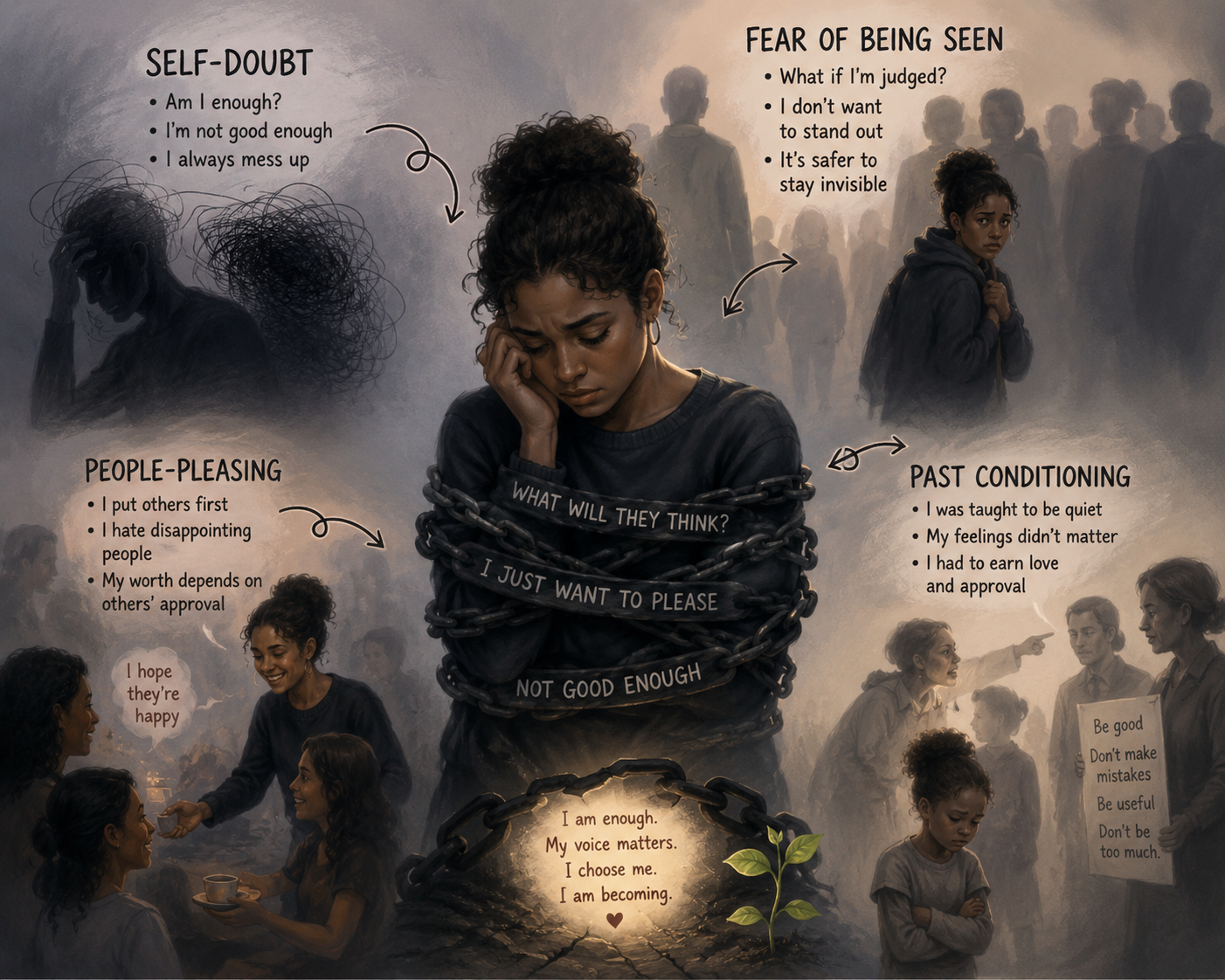
The Four Forces That Keep the Real Locked Away
- Self-Doubt – Self-doubt is not a lack of evidence. Plenty of people with degrees, promotions, and grateful clients still feel like they got away with something. Doubt is a relationship with evidence. It discounts every success as luck, timing, or charm. Left unchallenged, it quietly sets a ceiling: you never apply, never pitch, never ask.
- Fear of Being Seen – Most people think they fear failure. Often they fear visibility. Being observed while trying. Failure in private is survivable; failure with witnesses feels like exposure. This is why many talented people over-prepare forever and launch nothing. Perfectionism is not standard; It is a delay tactic with good PR.
- People-pleasing – The freeze and fight responses are famous. Fawning is appeasement as protection: agree, soothe, accommodate, and the danger passes. In addition, it looks like an inability to say no, over-explaining, and a personality that changes shape depending on who is in the room. When everyone gets a vote on who you are, nobody meets you.
- The Past on Autopilot – Experiences do not stay in the past. They become rules.
- “Do not need much.”
- “Do not outshine your family.”
- “Be useful. Be gone.”
These rules were rational once. The tragedy is that they keep running after the environment that required them has disappeared.
What Hiding Actually Costs You
Hiding is not free. The invoices are usually paid in the following currencies:
- Chronic low-grade exhaustion.
- Loneliness inside a relationship.
- Resentment.
- A narrowing life.
- Identity confusion.
You are not lazy, broken, or dramatic. You are managing a safety system with impressive skills.
How to Become the Version of You That You Keep Hiding
- Identity does not change through insight.
- It changes through evidence.
- You need repeated experiences of being yourself.
- Not being destroyed.
Here is a sequence that works.
Step 1: Inventory the Edits
For one week, write down every moment you edited yourself. Not to judge it. Just to see it.
Note three things:
- What you actually thought
- What you said instead
- What you feared would happen
Step 2: Borrowed Values From Real Ones
List the ten things you believe you should want.
Beside each answer, ask yourself honestly:
- Who taught me this, and what happens if I stop wanting it?
- Anything that collapses into “people would be disappointed” is a borrowed value.
- Anything that survives is probably yours.
Step 3: Run Micro-Exposures
Do not start by confronting your mother.
Start where the stakes are low, and the reps are many.
- State one real preference a day.
- Let one silence sit for three seconds.
- Send one message without softening it.
- Say “let me think about it”.
- Share one opinion in a group per week.
Step 4: Learn to Tolerate Disappointment
This is the skill. Becoming yourself means some people get a version of you they did not sign up for. Some will adjust. A few will leave.
Step 5: Build a Rehearsal Space
You need at least one relationship or room where the unedited is welcome.
- A therapist
- One blunt friend
- A journal
- A community
- A faith practice
Expect the Grief
Nobody warns you about this part. Becoming yourself involves mourning the years spent performing and sometimes mourning relationships that only worked while you were smaller.
What the Research Says
- Higher trait authenticity is consistently linked with life satisfaction, self-esteem, and better relationship quality across cultures.
- Self-compassion predicts resilience more reliably than self-esteem.
- Self-efficacy grows primarily through mastery experiences.
- Shame thrives in secrecy and shrinks in the presence of empathy.
Key Takeaways
- Hiding is a learning safety strategy, not a character flaw.
- Four forces maintain it: fear of visibility, people-pleasing, self-doubt, and unexamined past rules.
- The costs are exhaustion, loneliness, resentment, and a narrowing life.
- Identity changes through repeated evidence.
- Expect disappointment and grief the way will make you feel happy.

The Waiting Version
The version of you that you keep hiding is not a fantasy self.
It is not a better-looking, more productive upgrade.
It is simply you unedited.
The one who had opinions before you learned which ones were acceptable. You will not become that person in a brave weekend.
You will become them the way anyone becomes anything: one sentence at a time.
Frequently Asked Questions
What happens when you hide yourself?
Hiding yourself means you constantly change what you think, what you need, what you want to achieve, or who you are just so other people feel okay with you.
How do I know if I am trying too hard to please others or if I am just being nice?
Being kind is something you can choose to do or not do. Trying hard to please others is something you feel like you have to do.
How long does it take to be yourself?
Most people start noticing meaningful change within three to six months of consistent practice.
Do I need to go to therapy to stop hiding myself?
Not always, but professional support can be helpful if the pattern is connected to trauma or long-term shame.